History
From regional collaboration to a hemispheric initiative
Pan American Wildland Fire began as a collaborative program in Mexico in 2019, bringing together forest brigades from Sierra San Pedro Mártir National Park and municipal firefighters from Tijuana, Ensenada, and Tecate in partnership with the conservation organization Terra Peninsular.
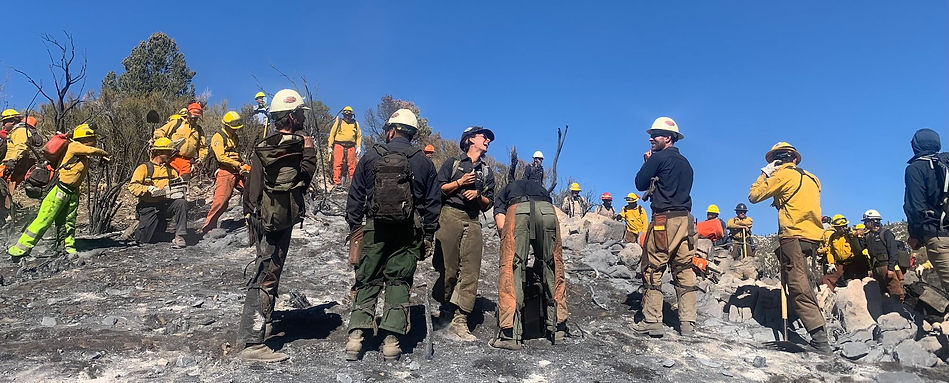
The experience highlighted the strength of hands-on collaboration and knowledge exchange across regions and agencies. Building on these relationships, Pan American Wildland Fire gradually grew into a hemispheric initiative working alongside communities and fire organizations across the Americas.

Our Work
Working alongside communities from Mexico to Argentina
01
Mexico
For the past seven years, we have worked in the high-desert pine forests of Parque Nacional Sierra de San Pedro Mártir in collaboration with Comisión Nacional de Áreas Naturales Protegidas (CONANP), Observatorio Astronómico Nacional (OAN), and Terra Peninsular.
Together, we host an annual week-long intercambio de experiencias (“exchange of experiences”) that combines experiential learning with hands-on fire management and conservation projects.
Courses focus on foundational firefighting skills, fire management tactics, and leadership development. Participants work in rotating crews, taking on daily leadership responsibilities throughout the training.
As the week progresses, instruction becomes increasingly advanced, helping participants evaluate infrastructure and surrounding landscapes through the lens of wildfire vulnerability and risk.
Participants leave the course prepared to bring their training back to their home organizations and communities, strengthening local capacity through shared knowledge and leadership.
View a sample course schedule for a closer look at the program structure and training components.
In addition to the learning and exchange that take place throughout the week, the program also supports a range of on-the-ground conservation and fire management projects.

Program accomplishments to date:
-
Removal of 75 hazardous dead trees from campgrounds, road corridors, and areas surrounding park infrastructure
-
Preparation of 2.14 kilometers of prescribed fire control lines around designated burn units
-
Creation of four hectares of defensible space around park and observatory infrastructure to reduce wildfire risk
-
Training of 140 fire and land management personnel from across Mexico, including representatives from Comisión Nacional Forestal (CONAFOR), Comisión Nacional de Áreas Naturales Protegidas (CONANP), Observatorio Astronómico Nacional (OAN), municipal fire departments, private ranches, nonprofit park organizations, the Mexican Army, and rural brigades
02
Brazil
Building on their experience in Mexico, several of our volunteer instructors were invited to work for the U.S. Forest Service International Programs in Brazil (not associated with Pan American Wildland Fire or other nonprofit initiatives) to implement the same experiential, train-the-trainer course model.
Courses were held in the Brasília National Forest in 2023 and again at the Brasília Botanical Garden in 2024, with participants including firefighters and land management professionals from federal and state agencies across Brazil.

03
Argentina
Beginning in January 2027, we will launch a week-long training program in collaboration with communities in the Patagonian region surrounding El Bolsón. The program will address growing wildfire risk in a region that has faced increasingly severe fire events in recent years.
Working alongside volunteer fire brigades, government agencies, and local residents, the program will focus on two primary goals:
1. strengthening community resilience through the creation of defensible space, and
2. building local capacity for effective wildfire response through evacuation planning, fire defense strategies, and hands-on training with pumps, hoses, and firefighting equipment.

The course will be delivered through an experiential, community-based approach in which participants work directly within their own communities to reduce risk and engage in simulated fire response scenarios.
Programming will include hands-on training, community workshops, and bilingual instruction focused on preparedness and risk reduction.
The same training principles that have proven successful in Mexico and Brazil will be adapted to the specific environmental and community realities of Patagonia in support of long-term wildfire resilience.